
III · Working Equitation Competition
How does a Working Equitation competition work?
Working Equitation in the arena: the four trials, every obstacle named and defined, and the scoring system.
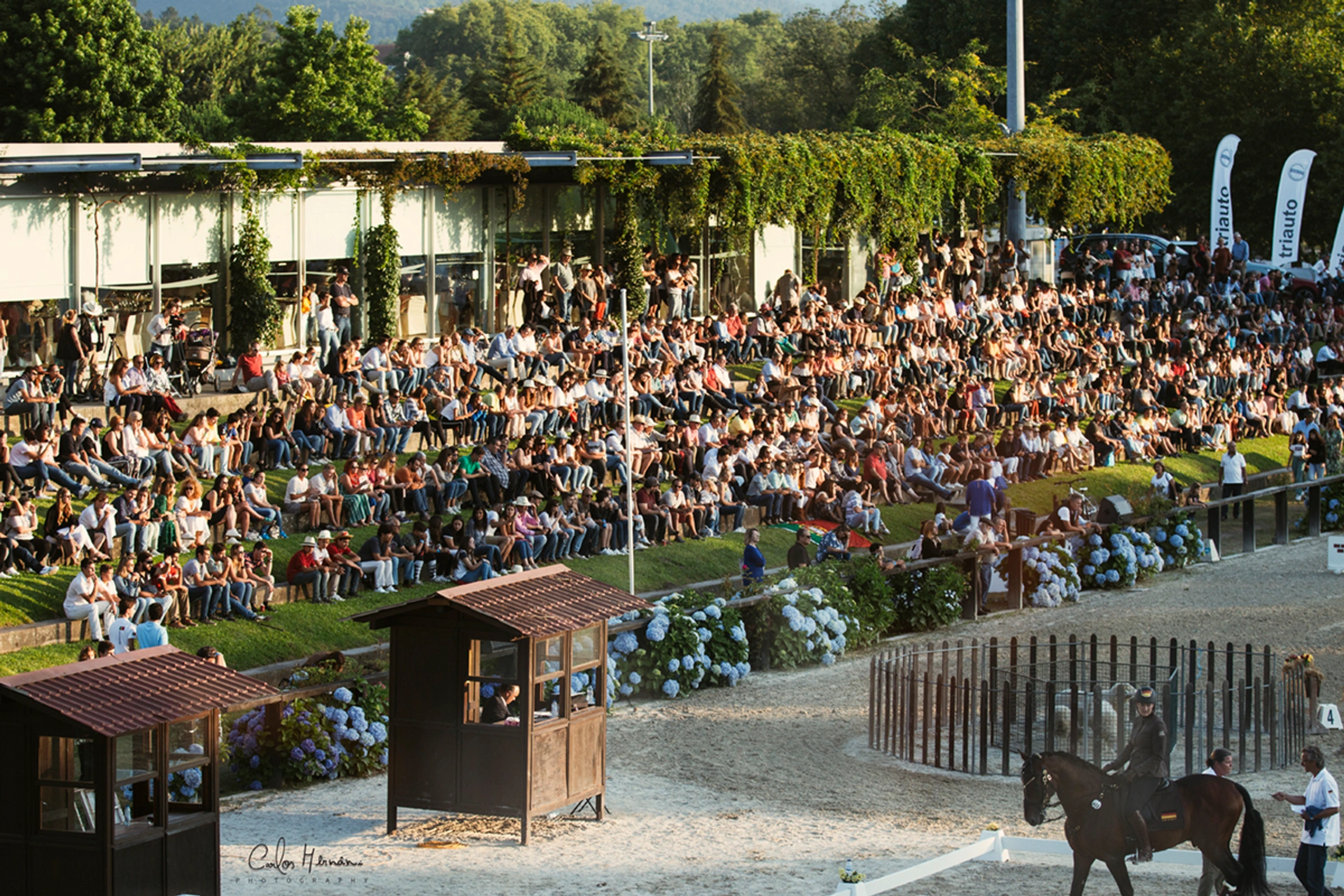
A Working Equitation competition runs the same horse and rider through four trials and adds the results together into one placing.
The four are Working Dressage, Ease of Handling, Speed and Cattle. Each produces its result in a different way. Working Dressage is ridden on the flat. Ease of Handling is ridden through a course of obstacles and marked for quality. Speed is the same kind of course against the clock. Cattle is ridden by a team, with live animals.
The overall placing depends on the results across the competition rather than the result of any one trial.
A rider can win one trial without leading the overall competition.
A strong Working Dressage result can be offset by a weaker obstacle round, and a fast Speed round can lose places once its penalties are added.
I · The Order the Trials Run In
Working Dressage comes first, then Ease of Handling, then Speed. Cattle, where it is held, comes last.
The order moves from the flat work into the obstacles and then onto the clock. Working Dressage is followed by Ease of Handling, and the obstacle work is then ridden against time in Speed.
If you are going to your first competition, expect one of two shapes. Small competitions often fit into a single day, with the dressage and the obstacles run one after the other and the Speed trial later on. Larger ones spread across two or three days, giving each trial its own session and letting horse and rider recover in between.
The Cattle trial requires live animals, suitable ground and a team of riders, so it is less commonly offered than the first three trials. At international championships it forms part of the Team Championship and also has its own classification.
Read next The four trials of Working Equitation
II · How the Trials Are Scored
The trials produce results in different ways before their placings are converted into points.
Working Dressage is marked. The rider performs a set sequence of exercises, and the judge gives each one a mark from 0 to 10. At the end, five collective marks are awarded for the ride as a whole.
Ease of Handling is marked the same way. Each obstacle receives a mark from 0 to 10 for the quality with which it was ridden, and collective marks follow at the end.
Speed is timed. The clock runs, penalties in seconds are added for faults, and one bonus is available. The quickest corrected time wins the trial.
Cattle is timed as well. Riders are classified by the time taken plus any penalties. There is no mark out of ten anywhere in the Cattle trial.
Read next How Working Equitation is scored, in full
III · How the Results Become One Placing
The four different currencies are made comparable by turning each trial's finishing order into points.
Under the international rules, every competitor receives one point for taking part, plus one more for each rider ahead of them. Internationally, in a class of twenty, that gives the winner 21 points, second 19, third 18, and so on down to one point for last place. A rider disqualified in a trial is ranked last in it, and counts as one point in every trial that follows.
The Portuguese national rules work the same way. First place scores one more than the number of competitors, second scores one less than that number, third one less again.
Add the points from every trial and you have the general classification.
Under the Portuguese rules, all tests carry equal weight in that general classification, a coefficient of one each.
IV · The Three International Classifications
A world or continental championship produces three separate classifications.
The Team Championship covers all four trials. Each nation enters a minimum of three riders and a maximum of four, and the best three results in each of the four trials count towards the team's placing. Under WAWE, participation in the Cattle trial is required for inclusion in the Team Championship classification.
The Individual Championship covers the first three trials only: Working Dressage, Ease of Handling and Speed. It is ordered first by the number of trials a rider completed, and then by the number of points scored.
The Cattle Trial Classification is calculated separately from the Individual and Team Championships.
The Team Championship, Individual Championship and Cattle Trial Classification are separate results and may therefore have different winners.
V · What Happens When Riders Tie
Ties are broken by where a rider finished in each trial, in a fixed order of priority.
Internationally, both the team and the individual tiebreaks use Working Dressage first, then Ease of Handling, then Speed.
The Portuguese national tiebreak uses the number of completed tests first, then total points, then the Working Dressage percentage, then the Manageability percentage, and finally the Speed trial time.
In both systems, Working Dressage appears before Ease of Handling and Speed in the tiebreak order.
VI · Who Writes the Rules
WAWE writes the international regulations governing world and continental championships. National governing bodies publish their own rules for domestic competition, including national level structures, dimensions and additional obstacles where applicable.
For example, the bridge is at least four metres long under WAWE and at least two metres long under APSL. The figures belong to different jurisdictions.
Throughout this Library, an international or general page states the international rule first and the national variation alongside it. A page about competing in one country states that country's rule first. Each rule is attributed to its governing body.
Read next Working Equitation rules, and where they differ
VII · One Partnership Across Four Trials
A Working Equitation competition separates the sport into four trials, but the same horse and rider carry through all of them.
Dressage asks for the work in a controlled test. Ease of Handling takes that training through obstacles where line, balance and responsiveness have to survive a changing course. Speed keeps the obstacles and changes the pressure, asking the partnership to preserve the work while time begins to matter. Cattle, where it is held, brings the original working purpose directly back into the arena.
For College Members, the competition becomes a way of reading how those demands connect.
A rider whose line is carefully organised in Ease of Handling may be able to preserve that line when the clock begins. Each trial therefore gives another view of the same training.
Branch One establishes what the four trials are and why each belongs to the discipline. Branch Three returns to competition with the result in front of the rider, bringing together course decisions, judging, penalties, strategy and the pressure of producing the work when it counts.
That is the useful connection for Members. The individual trials can be studied separately, while the competition asks one partnership to carry the same discipline through four different demands.
VIII · Where to Go Next
The eight pages below cover the main parts of the competition system.
Working Equitation Obstacles - every obstacle in the pool, with its regulated dimensions.
Working Equitation Rules - who governs, what the rulebooks say, and what ends a round.
Working Equitation Scoring - marks, penalties, points and classifications.
Working Equitation Levels - the three ladders, and what rises across them.
Working Dressage - the first trial.
Ease of Handling - the second trial.
The Speed Trial - the third trial.
The Cattle Trial - the fourth trial.
Contents
8 articles in Working Equitation Competition.