Working Equitation Dress and Turnout
Riders compete in the working dress of their own country, and the international rules require it.
The four national forms of dress came from the working traditions behind the sport. Working Equitation retains those different national forms rather than using one international competition uniform.
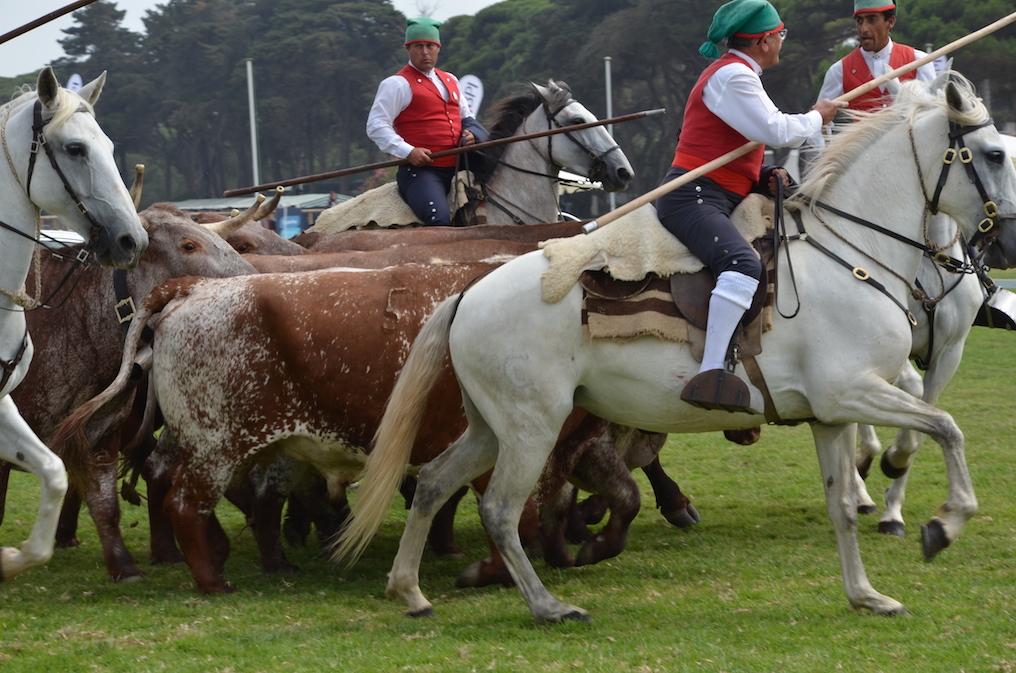
I · Portugal, the traje à portuguesa
The Portuguese Riding Costume: a jaleca, a short close-fitting jacket ending near the waist; high trousers finishing clean at the ankle; a wide-brimmed hat in black, grey or brown.
The Portuguese boot has a distinctive low, wide shelf heel that projects behind the boot, built to seat the lyre-shaped Portuguese spur.
At the waist is the faixa, a sash. It once carried a colour code that told you who the rider was: black for a working peasant, blue or red for a campino, black for a landowner.
II · Spain, the traje corto
The short suit of the vaquero of the dehesas: a sombrero de ala ancha; a short jacket fastened high over a white shirt; high-waisted trousers; and zahones, leather chaps. The colours run to grey, black and dark blue. The Portuguese jacket is cut straight across the back. The Spanish jacket is shaped in at the waist, because the Spanish saddle has a higher rear arch and a straight-cut jacket would sit badly on it.
Read next The vaquera saddle
III · France, the Camargue gardian
The older form was leather breeches, gaiters and the taillole, a wide band of red wool at the waist.
The modern form settled in the 1920s, largely through Folco de Baroncelli-Javon: a felt hat, a printed or floral shirt, moleskin trousers, a velvet jacket and boots.
IV · Italy, the butteri
The mounted herdsmen of the Maremma ride in a wide-brimmed hat, a working jacket and stout leather leg protection, and carry the uncino, a long hooked staff.
V · What the Rules Require
Internationally. At a WAWE championship every competitor rides in the National Working Equitation costume of their own country. Each member nation sends WAWE a written description of its dress and tack one month before the event. A nation that does not is marked down on presentation.
In Portugal. The APSL requires the Portuguese Riding Costume of every competitor and allows no garment belonging to another kind of attire.
In the United States. USAWE permits riders to compete in the working tack and attire of the nationality of their choosing: Western, Spanish or Vaquera, Portuguese, English, or Australian stock. Its rules add that dress "should not be an area where personal preference influences the marks."
The dress is worn as one national tradition rather than assembled from garments belonging to several traditions. Where the rules specify penalties for mixed turnout, those rules apply.
The permitted choice depends on the governing body.
VI · What You Need at Your First Competition
At the lower levels, the requirements may be simpler than the full national turnout seen at international competition.
Portugal, for instance, does not require the full Portuguese Riding Costume in its Preliminary category.
Check your own federation's current rules before you enter, because the detail varies by country and by level.
Under the WAWE rules, helmets are mandatory for Juniors and Young Riders in all tests, in warm-up and at the veterinary inspection, and are recommended for Seniors. Portugal requires the toque for riders under eighteen. No rider is ever marked down for wearing protective equipment.
VII · Turnout
Turnout includes the horse, tack and rider.
The Paddock Officer checks attire and tack before and after every test. Protective boots or bandages are allowed in Ease of Handling, Speed and Cattle; overreach boots in Speed and Cattle. Fly hats may be permitted in outdoor competitions at the President of the Jury's discretion, and must be removed after the test so that the bits, spurs and ears can be checked.
VIII · Why the Sport Kept Four Traditions
The regulations state the aim directly: to preserve the traditions, attire and tack that form part of the equestrian cultural heritage of each nation.
The purpose is to retain the working dress associated with the national traditions rather than replace it with one international uniform.
Read next The four traditions
IX · Dress Belongs to the Riding
The four national traditions look different because their working lives were different. Their clothing developed around horses, saddles, weather, terrain and the jobs riders had to perform.
That makes dress more interesting than appearance alone.
A jacket cut, the position of a leg, the height of a boot or the shape of a heel all sit beside equipment that developed within the same riding tradition. Together they form a practical arrangement around the rider.
For College Members, the study begins to read turnout in that wider context.
The question becomes how the rider, clothing, saddle and equipment belong together, and why the competition preserves those relationships rather than reducing four traditions to one international uniform.
That gives turnout a useful place in the study of Working Equitation. What appears in the arena as national dress is also evidence of the riding culture that produced it.
Where Branch One gives Members the four traditions and the dress that came from them, Branch Three carries that inheritance into competition, and turnout, tack and the regulations around them become part of presenting the tradition correctly in the arena. The study therefore connects what the rider wears with the riding culture it came from and the competition in which it now appears.